Causes
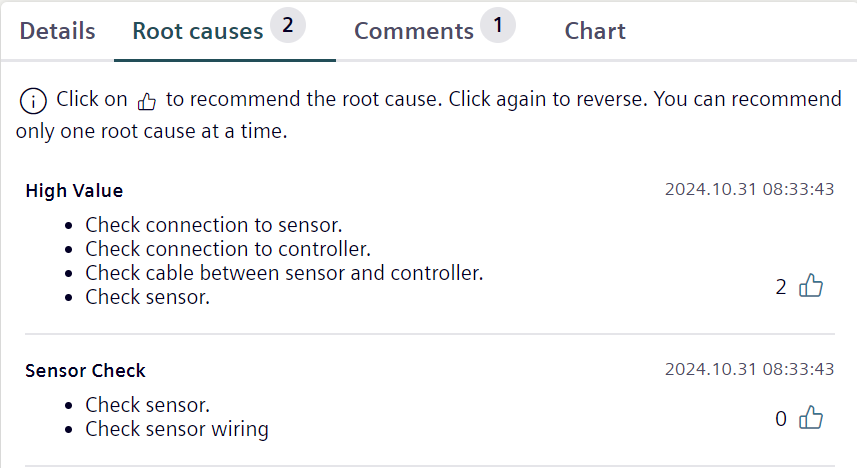
The 'Root causes' tab displays the root cause for a plant in alarm. It can display one or multiple root causes simultaneously. A 'Like' ( ) can assign a greater weighting to the root cause. Root causes with the most 'Likes' display at the top of the list of root causes.
Set root causes for an alarm with programming knowledge
Root causes are programmed in the Rule Editor or, alternatively, in the Scripting Editor. This requires access to the 'Rule Editor' or 'Scripting Editor'. Both tools create root causes using simple programming tools from predefined program blocks.
- For the Rule Editor: See 'Rule Editor menu'.
- For the Scripting Editor: See 'Script editor'.
Set root causes for an alarm without programming skills
Another possibility is to assign root causes to a plant when configuring an alarm type. The 'Create alarm type’ function offers, in addition to the two programming tools, a low-threshold configuration that does not require programming skills or access to the 'Rule Editor' or 'Scripting Editor'.
- See 'Create alarm type'. Section 'Root causes'.
- Requirement: Pre-programmed root causes already exists that can then be assigned to an alarm.
Note: If causes for an alarm were created in either the 'Rule Editor' or the 'Scripting Editor' tools, as well as in the 'Alarm type' function, then the cause from the tool takes precedence over the cause from the 'Alarm type' function.
- In other words, root causes from the programming tools overwrite root causes from the 'Alarm type’ function.
Root causes' tab: Weighting root causes
- Select the Root causes tab.
- One or more recommendations for alarm handling are displayed.
- Click Click on the most reasonable or most appropriate recommendation for the alarm.
- A recommendation with 'Like' has a higher weighting.
- Recommendations with 'Like' display higher in the hit list for alarm root causes.
- The 'Likes' for alarm root causes are added up and the alarm root cause with the most 'Likes' displays at the top of the list.
- Note: Only one 'Like' can be assigned per plant alarm.
- Alarm root causes with the most suitable recommendations are displayed in the first position and are most likely to be considered when handling an alarm.